

Texas Medicaid Health Plans have won the administrative overhead battle. According to the Texas Association of Health Plans (TAHP), 91 cents of every Medicaid dollar goes into direct patient care. Administrative and profits are capped, while savings get back to the state.
This benefits taxpayers but limits operating flexibility for health plan COOs. With constrained administrative budgets and thin margins, plans must expand capacity through more efficient workflows, not higher spending.
The largest opportunity to expand capacity lies in the second-largest spending category at 26.4 cents of every Medicaid dollar. This funds the long term care and service coordination. In our work with Medicaid plans, documentation consumes more of the service coordinator's time than member care, making it a key operational bottleneck.
This article examines Texas Medicaid spending, the operational demands of service coordination, and how ambient AI can reduce documentation time and expand coordinator capacity. While Texas provides the context, payer leaders overseeing managed long-term services and support (MLTSS) in any state may face similar operational challenges.
Every Dollar Spent in One Table
TAHP reviewed the spending across all the 16 Medicaid health plans in Texas. After careful analysis, it sorted the 91 cents of direct care into five major categories.

The remaining 9 cents covers administration, taxes and plan profit.
This split reflects Texas’s risk-based managed care model. Texas pays a fixed premium per-member, per-month, while the plan includes financial risk. The state caps administrative spending and profits, and recovers savings through experience rebates, and accounts for every dollar in public financial statistical reports. And the results are: from 2012 to 2022, per-member Texas Medicaid costs increased 14%, compared with 52% growth in national healthcare costs.
The operating takeaway: For a plan, this has one practical consequence. With revenues and profit already capped, there’s little room to spend more. If any gain has to come, it should come from how the 91 cents is delivered.
The 26.4 Cents Runs on Coordinators
As said earlier, long-term care is the second largest spending of the Medicaid dollar. And TAHP is quite specific about how it spends it: home health aides, attendant care, and service coordinators to help older and disabled Texans to stay in own homes.
Service coordination is the core of STAR+PLUS and it runs through STAR Kids and STAR Health as well. A coordinator, often a nurse, visits the member, assesses their needs, builds and updates the individual service plan (ISP), authorizes services and follows up with providers. If it works, the member stays at home. When it doesn’t, the next stop is often a nursing facility, which is expensive for the plan.
Hence, the state sets a strict minimum for this work:
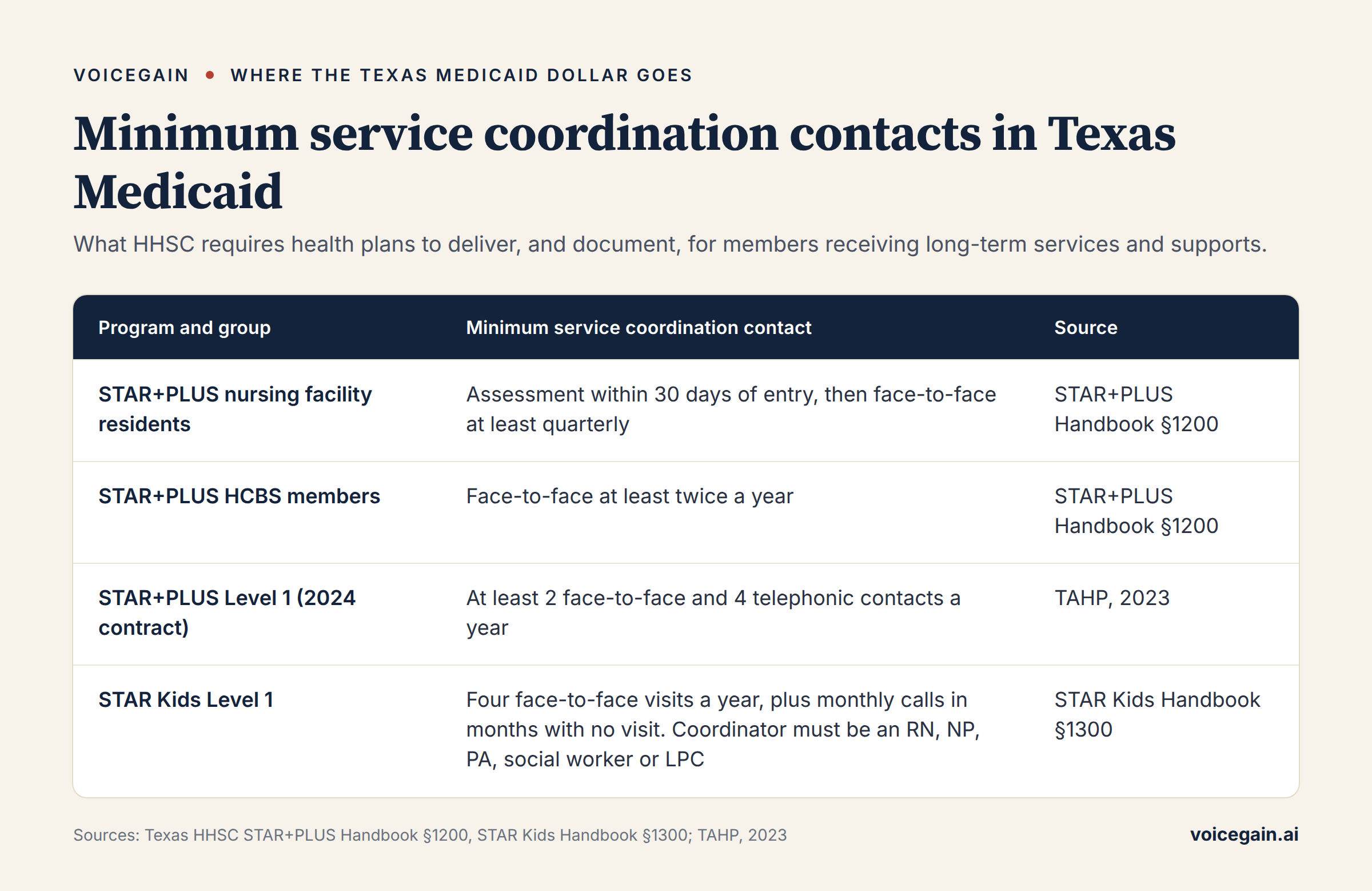
And the workload is rising. TAHP estimated that the 2024 STAR+PLUS requirements increased the touchpoints approximately from 327,000 to 780,000 a year. Also, plans would require approximately 400 additional nurses and nurse practitioners to maintain the pace.
That’s why for an operation leader, that becomes a capacity problem.
Where the Hours Go: Documentation, Audits and Turnover
Every Visit Must Be Documented
The STAR+PLUS handbook requires health plans to keep records that prove every required face-to-face visit took place. HHSC’s annual utilization review then examines these records in detail. Reviewers check whether the member’s needs were identified, whether visits were completed on time and whether the required topics were covered in each contact.
The results have been uneven. HHSC’s FY2025 review found a decrease in completed service coordination contracts among the STAR+PLUS HCBS plans it reviewed. An earlier HHS OIG audit found that at one plan, 38% of sampled Level 1 members had missed at least one required service coordination activity. These shortfalls can lead to corrective action plans, adding management workload and affecting contract performance.
The Documentation Burden on Every Visit
Care management leaders often point to the same operational pressure points. The table below outlines each one and how ambient AI addresses it.
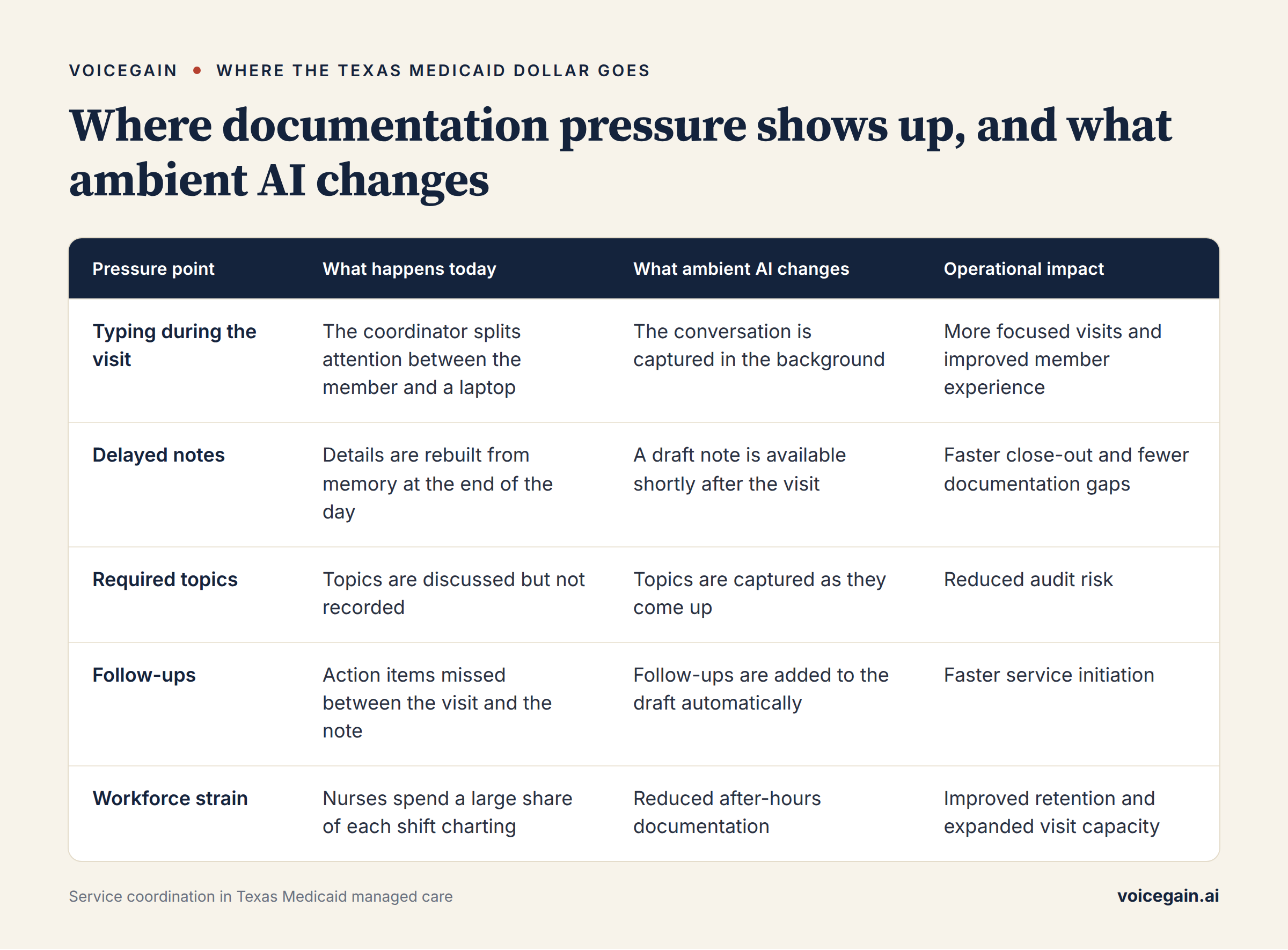
Limited Workforce Capacity
Nurses spend about 40% of their shift on documentation, according to AACN, citing the U.S. Surgeon General’s advisory on health worker burnout. Hospital RN turnover was 16.4% in 2024 and 22.3% of newly hired RNs left within their first year. Texas health plans that need to expand coordinator capacity are recruiting from the same limited workforce.
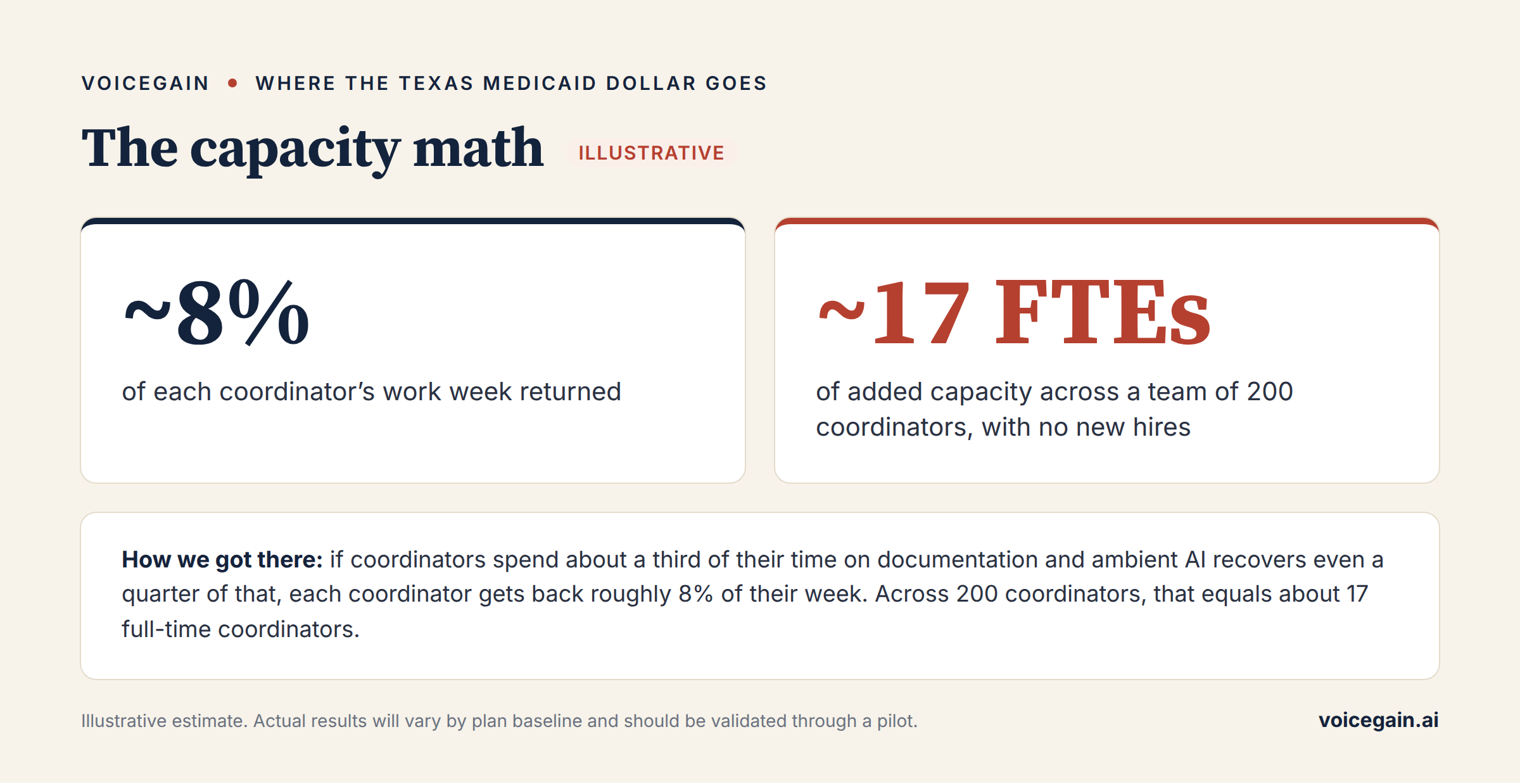
As a result, documentation time directly reduces the share of long-term care funding that reaches members.
What the Evidence on Ambient AI Shows
Ambient AI captures a conversation and generates draft documentation. In hospitals and clinics, it has moved quickly from pilot programs to routine use and early results are promising:
- Self-reported clinician burnout decreased from about 52% to 39% across six health systems (JAMA Network Open, October 2025). In a matched study, ambient scribe users spent 8.5% less total time in the EHR and more than 15% less time on note writing than their peers (UChicago Medicine).
- The Permanente Medical Group estimated that its physicians saved 15,791 hours of documentation time over approximately 63 weeks.
- One home health agency reported 50% documentation time savings using WellSky’s ambient tool.
These findings come with two limitations. Results vary across rollouts and depend on how implementation is managed. Most of the research also comes from clinic and hospital settings rather than service coordination visits in member’s homes.
We consider service coordination presents a strong use case for ambient AI. A coordinator visit produces a structured record that HHSC audits field by field, it is not just a clinical note. When AI captures the conversation and maps it to that record, it reduces documentation time and audit risk together.
How Voicegain Clara Works on a Home Visit
Voicegain Clara is our ambient listening solution for home-based care. During a service coordination visit, the workflow follows five steps:
- The coordinator gets the member’s consent before any recording begins.
- Clara listens on a laptop (or any device used by the Service Co-ordinator) during the conversation, allowing the coordinator to stay focused on the member rather than the keyboard.
- The conversation is recorded and transcribed, with each speaker identified.
- Clara generates draft documentation, including the visit note, assessment inputs, ISP updates and follow-ups such as an equipment order or a missed attendant shift.
- The coordinator reviews, edits and signs the documentation. No information enters the record until the coordinator approves it.
Clara prepares the draft, while the coordinator remains responsible for every decision.
Questions from Security and Compliance Teams
Where is the data stored? Clara can be deployed in Voicegain’s HIPAA and SOC-2 compliant cloud or in the Health Plan’s own VPC so recordings remain within the Plan's firewall.
How is PHI protected? PHI can be redacted from transcripts.
How does Clara support language access? Clara supports more than 99 languages, including Spanish, which many Texas families speak at home.
Who is accountable for the final case-notes? The coordinator. Every note is reviewed and accepted by the Service Co-ordinator before it is saved.
Service coordination continues after the home visit ends. Members call about authorizations and attendant schedules, providers call about eligibility and claims and coordinators make scheduled phone contacts, such as the monthly calls required for STAR Kids Level 1 members.
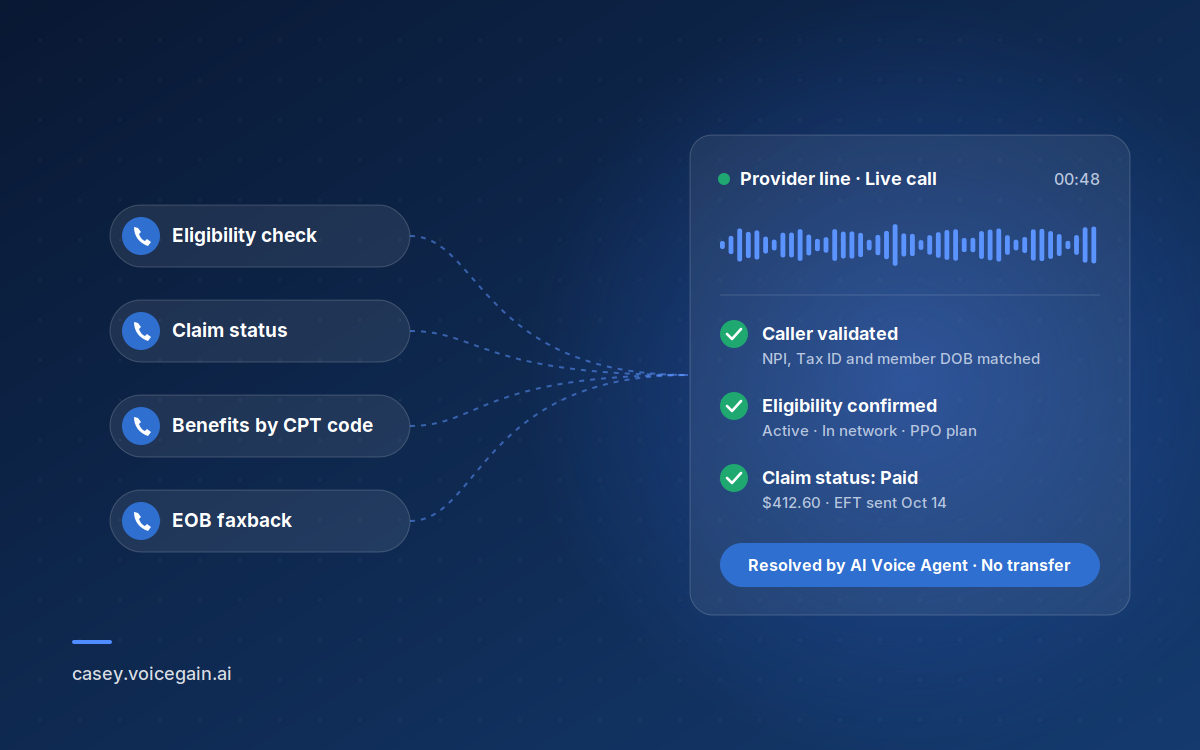
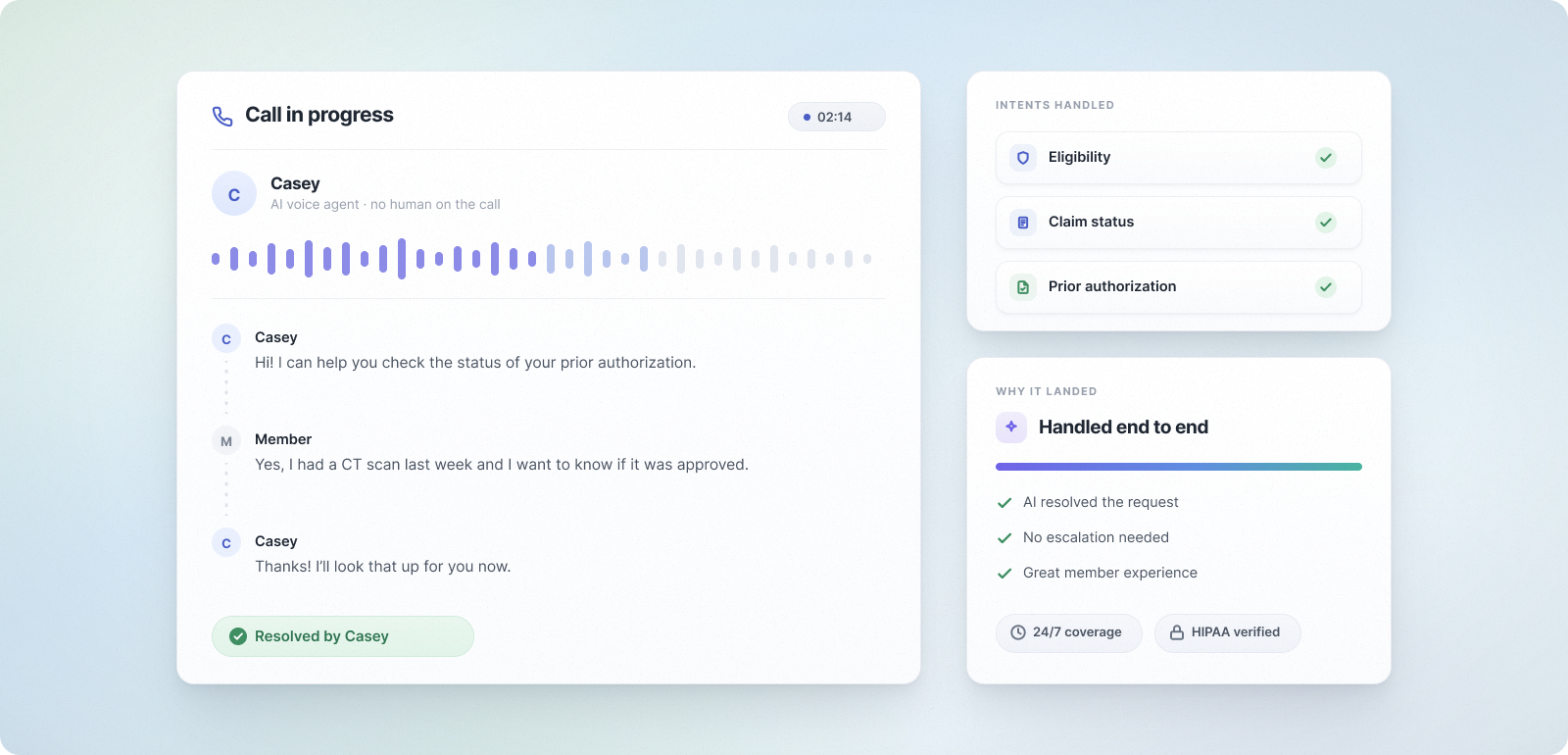
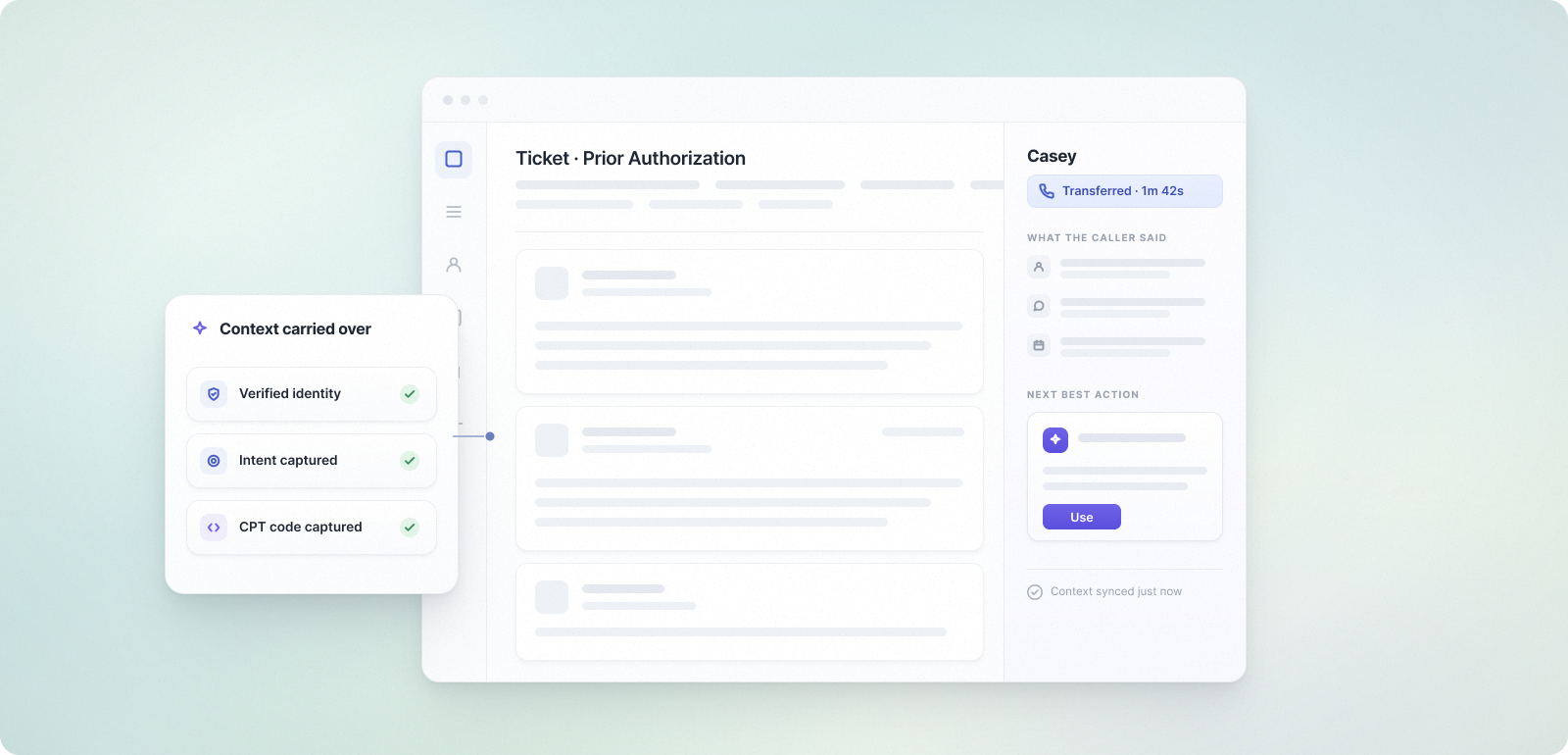
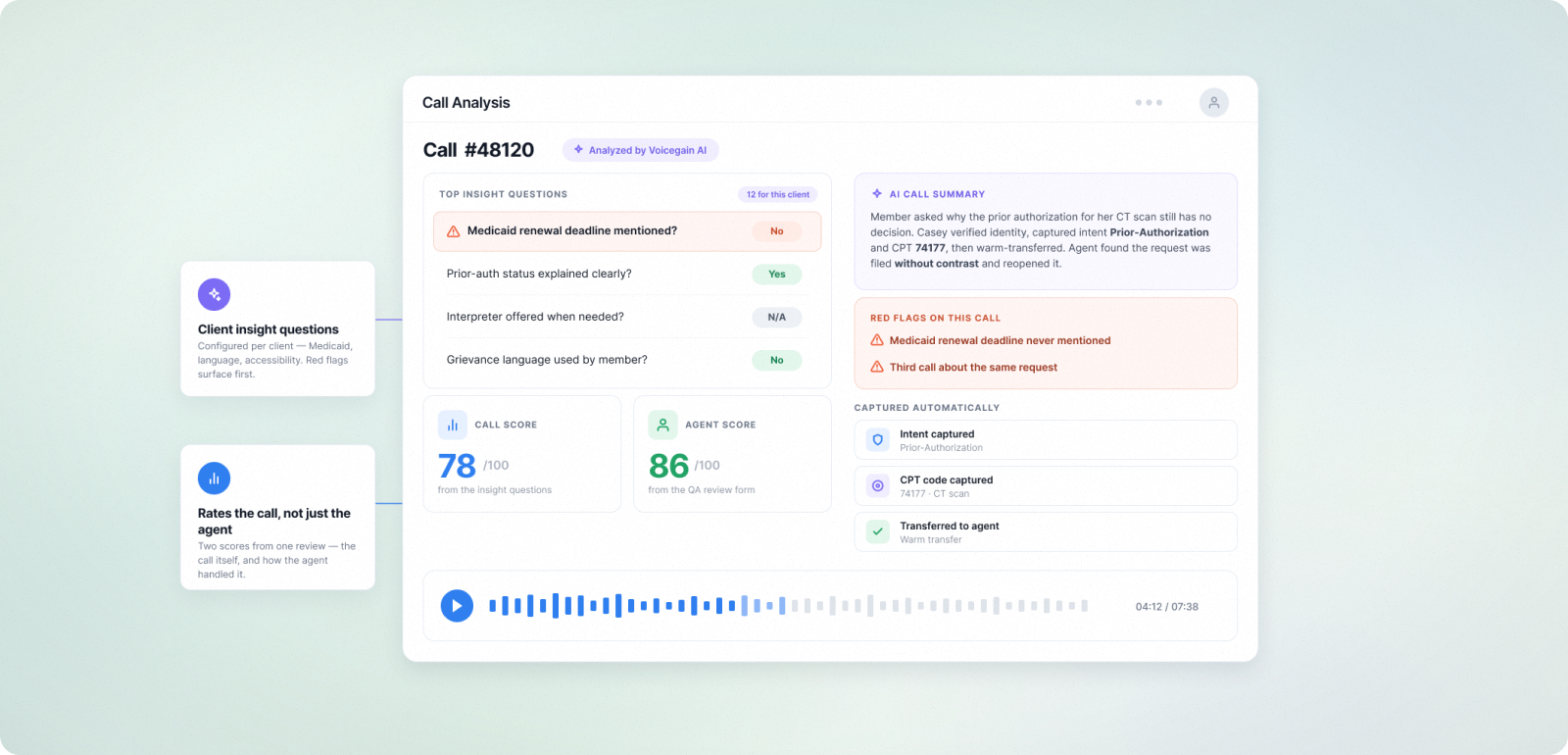
Voicegain Casey supports this part of the member relationship. Casey’s AI voice agent answers routine member and provider calls, including eligibility claim status and prior authorization status and transfers other calls to a representative with full context. Casey Co-Pilot assists coordinators and representatives during live calls and Casey QA reviews every call for compliance.
A 90-Day Pilot Plan for Operations Leaders
Health plans do not need an enterprise-wide rollout to demonstrate value. A focused pilot with a single coordinator team can provide the data needed to evaluate results.
- Start with the most documentation-heavy visits. Initial assessments and annual reassessments typically require the most documentation time, so time savings appear fastest there.
- Map the note template. Define which assessment and ISP fields the AI should draft and include HHSC’s required topics in that list.
- Approve consent language early. Legal and compliance teams should approve the consent script, in both English and Spanish, before the first visit.
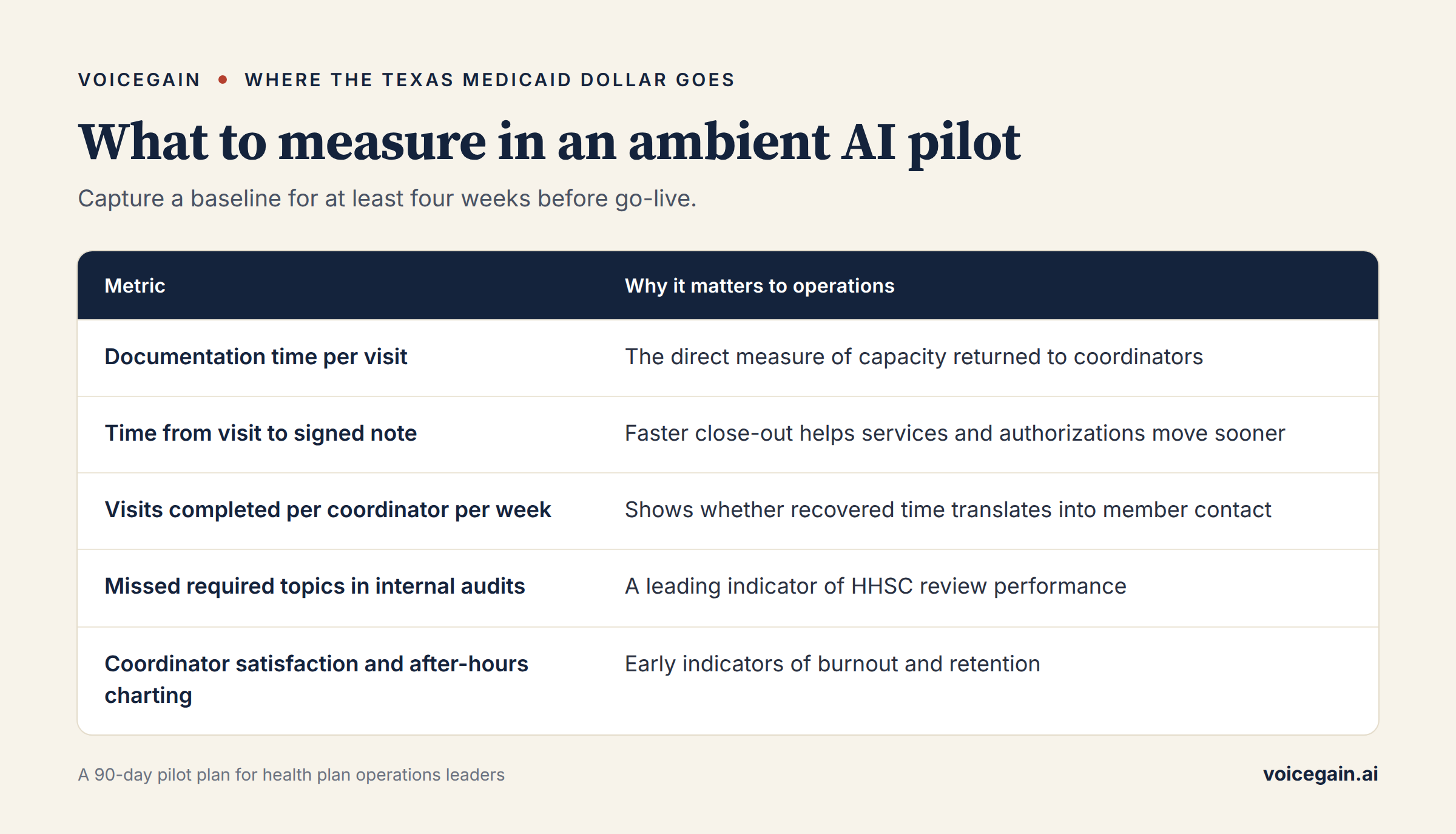
- Establish a baseline. Collect the metrics below for at least four weeks before go-live to support a reliable comparison for leadership review.
- Include human sign-off in policy. Policy should state that coordinators review and sign every note. This reflects good practice and meets auditor expectations.
The Bottom Line
Texas has already done the hard work on overhead. 91 cents of every dollar reaches direct care and the caps and rebates keep it that way. The next gain is giving service coordinators their time back, so more of the 26.4 cents for long-term care becomes time spent with members.
If you lead service coordination, care management or member services at Texas Medicaid, get in touch with us.
Frequently Asked Questions
How much of the Texas Medicaid dollar goes to care?
91 cents, according to TAHP’s September 2026 analysis of the state’s 16 Medicaid health plans. Hospital and emergency care accounts for 34.3 cents, long-term care for 26.4 cents, doctor visits for 13.6 cents, prescription drugs for 9.7 cents and other services for 7 cents.
What is STAR+PLUS service coordination?
It is specialized care management for STAR+PLUS members who need additional support. A named coordinator visits the member, assesses needs, develops an individual service plan and works with providers to deliver long-term services and support.
Can ambient listening be used in a member’s home?
Yes, with the member’s consent. Voicegain Clara captures the visit and generates draft documentation, which the coordinator reviews and signs before it is saved. Clara can be deployed in the health plan’s own cloud, on-premises or in an air-gapped environment.
What should a health plan measure in an ambient AI pilot?
Key metrics include documentation time per visit, time from visit to signed note, visits completed per coordinator, missed required topics in internal audits and coordinator satisfaction. Health plans should establish a baseline for each metric before go-live.
Does AI replace the service coordinator?
No. Clara generates draft documentation and Casey handles routine calls, but the coordinator makes every decision about the member’s care and signs every note.