

This scene plays out in every TPA and Health Plan Call Center. It’s 9am on a Monday morning and a billing specialist at an Orthopedic practice that is in your network has a stack of pending claims. The specialist calls up your provider services toll free number works through the phone tree, reads out the NPI and Tax ID, and waits on hold. After a long wait, when an agent picks up, the agent finds the member, opens up the claims system and reads back the status of the claim. The real work here is just a couple of minutes but the wait time may be hours.
Now, imagine doing this thousands of times a day. That is the reality of provider queues at most health plans and TPA call centers. These calls are repetitive, predictable and even structured. That’s why automating these calls is low hanging fruit and payer contact centers are now starting to use AI Voice Agents to automate these calls.
In our experience of implementing over a dozen AI Voice Agent for health care payers, the natural language conversation is not the difficult part. How many provider calls you can automate depends on whether an AI voice agent can access accurate eligibility, benefits and claims data in real-time and hand off to your call center team with full context when it can’t finish the job.
In this blog, we’ll explore why provider calls continue to stack up, which call types contribute most to the volume, which integrations enable automation and on ground results and outcomes of using Casey in production.
Why Provider Calls are Still a Big Problem
Portals and EDI didn't end the phone call
The industry has been doing this for 20 years and much of it has been successful: taking routine transactions online. The 2025 CAQH index shows medical plans have reported 96% full electronic adoption for eligibility/benefit verification and electronic claim status inquiries have increased to 81%.
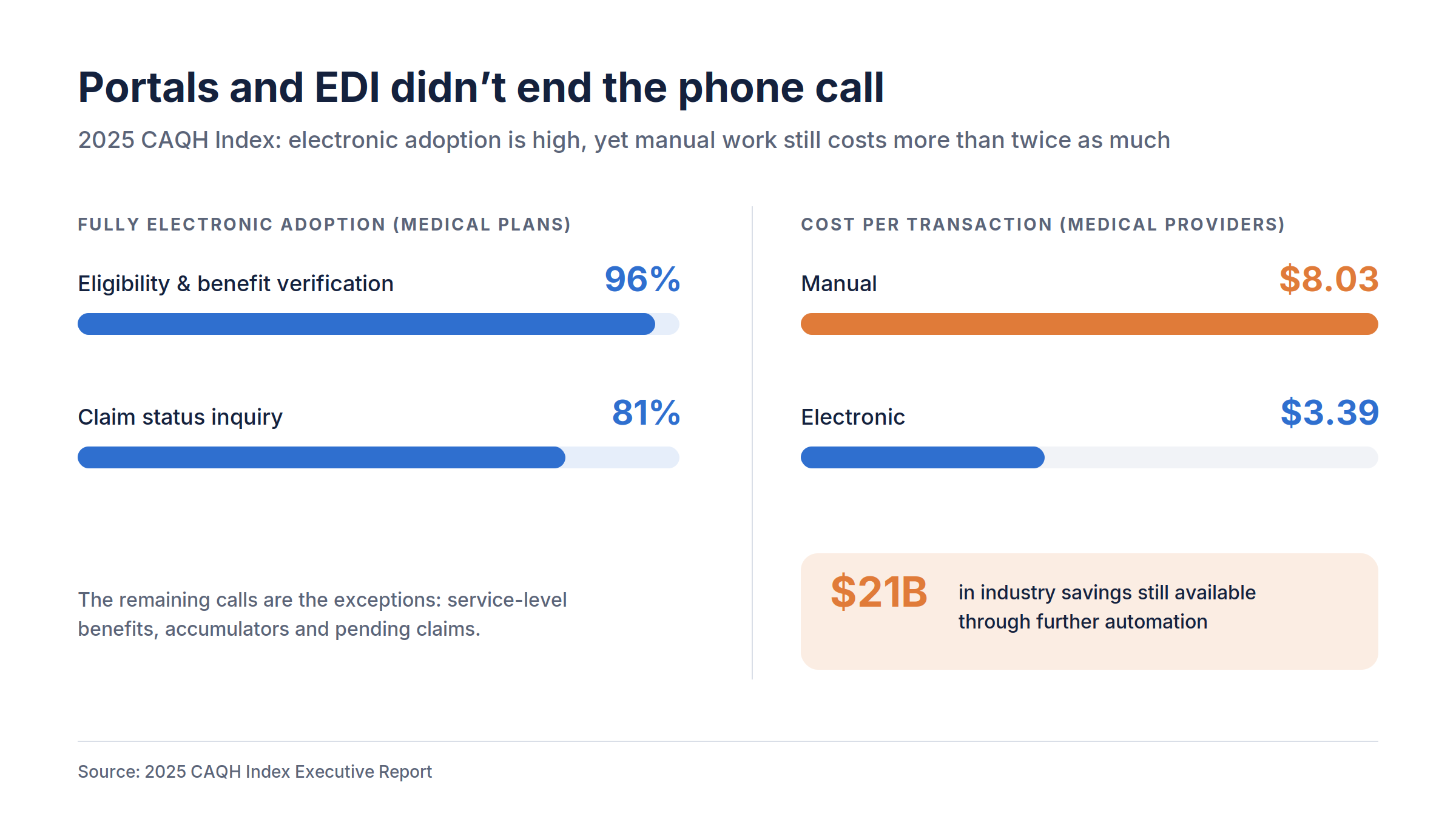
But the phones are still ringing. A 271-eligibility response can confirm a member is active but doesn't answer if a specific procedure is covered, what portion of the deductible has been met (accumulators as the industry calls it) or why a claim is pending. Back in 2018, the CAQH index noted that growth in electronic transactions was not matched by a drop in costly manual phone transactions. Provider calls are where the exception and portal gaps end up.
Manual work costs more than twice as much
The 2025 CAQH index shows that for medical providers, the cost of a manual transaction was $8.03 while an electronic transaction was $3.39. Despite the medical transaction volume increasing by 10% to 68.8 billion, CAQH estimates that there is still approximately $21 billion in savings through additional automation. Each manual inquiry on the provider side has someone on the payer side picking up the phone.
Staffing is not able to keep up
Based on our survey of over a 25 healthcare payer call center leaders, the average cost per call is $6 - $8 and each agent was able to answer approximately 40-50 calls per day . Call center staff turnover is 30% to 40% per year and a lot of time is wasted recruiting and training new hires to answer the same questions.
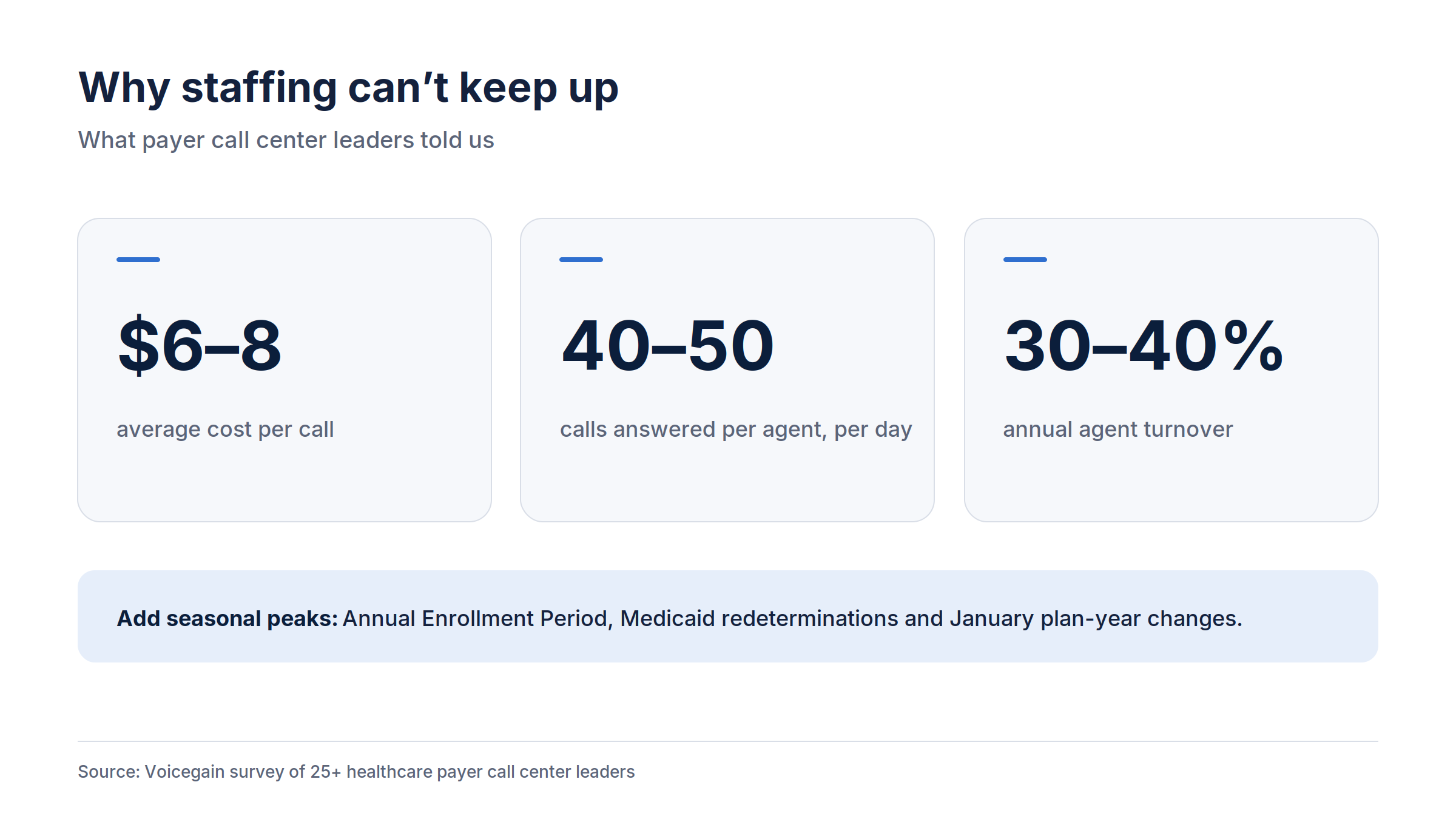
Seasonal peaks add to the strain. Volume can increase simultaneously during the Annual Enrollment Period, Medicaid redetermination and January plan-year changes. Those calls can be routed to a traditional IVR, but it can’t solve them.
For health plans: Provider relationships are undermined by slow responses. If a practice doesn’t have a clear answer on eligibility or a pending claim, the delay often reaches members via a rescheduled visit or a surprise bill.
For TPAs: Growth brings more calls. Every new employer group is self-funded and has its own Summary Plan Description (SPD), its own benefit rules and its own number of provider calls. Without TPA call center automation, more covered lives usually means more seats, more training and more IT overhead.
Most Common Provider Call Intents
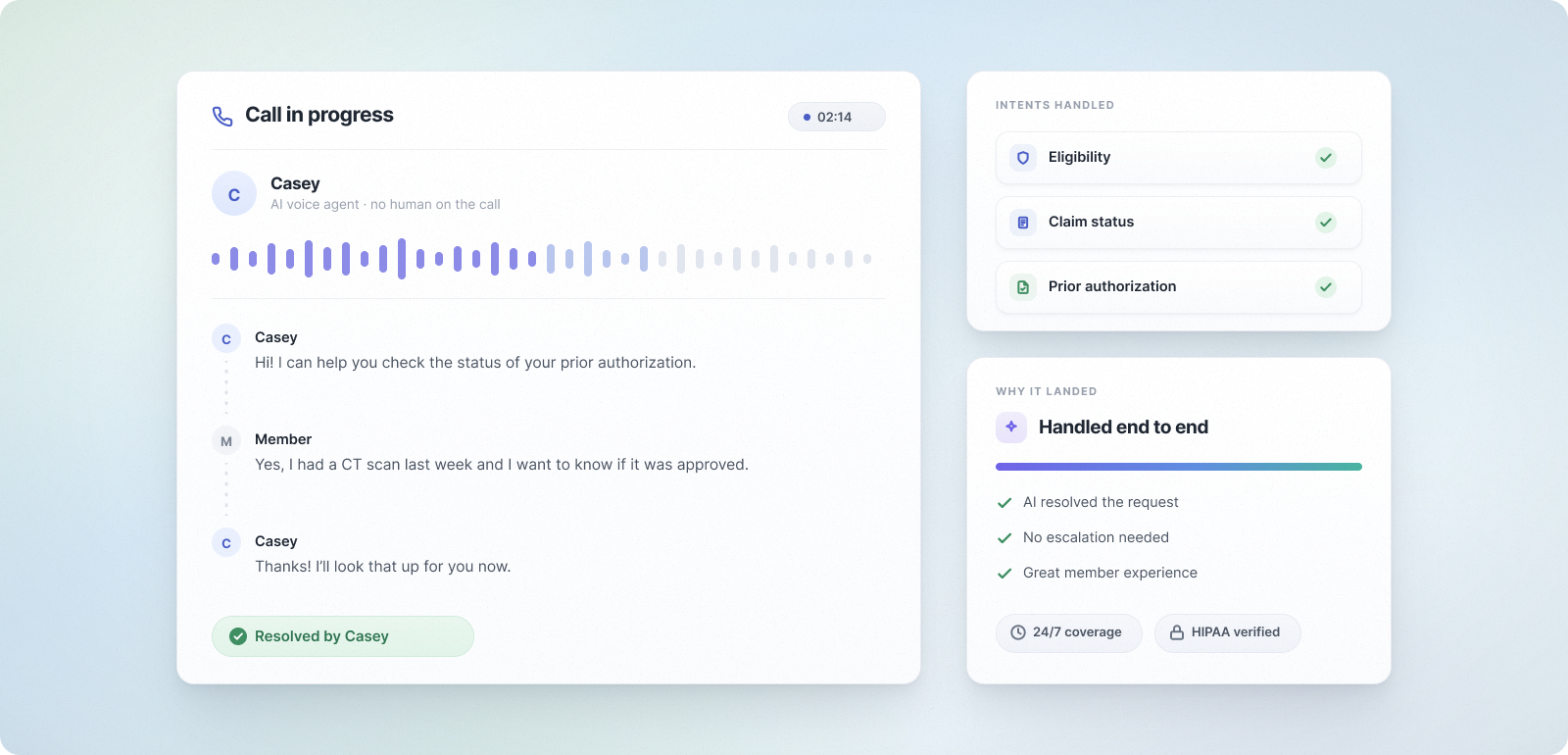
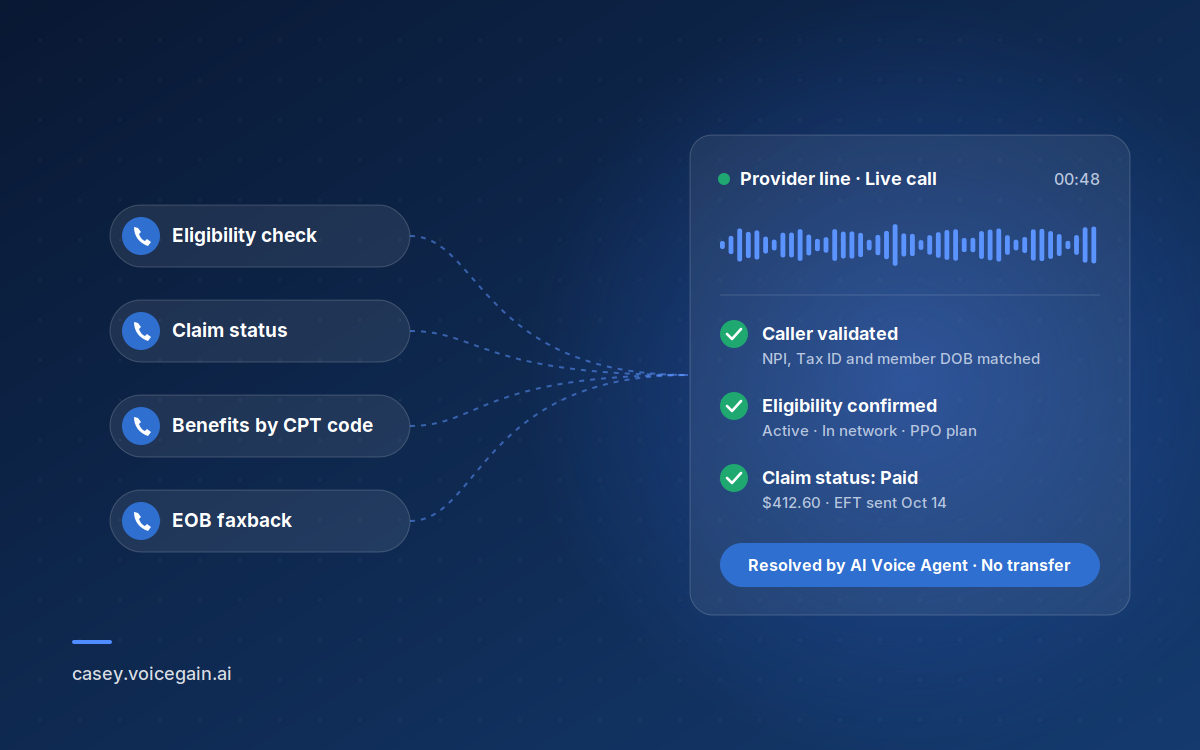
There’s a short list of call types that generate a large amount of provider volume across the health plans and TPAs we work with. Each one starts the same way: the caller has to be validated for HIPAA before any information can be shared.
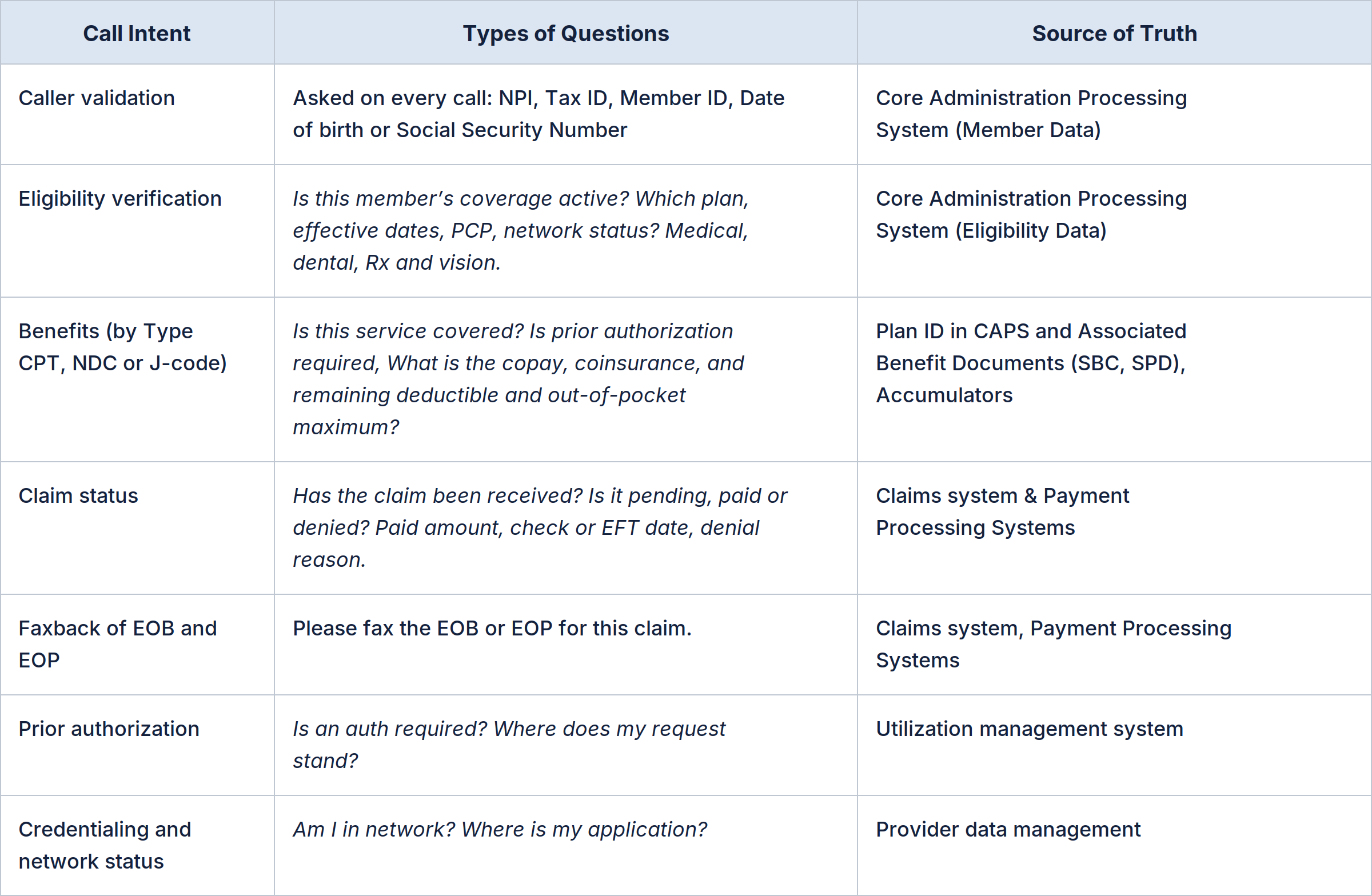
These calls have a lot in common. The questions are predictable, the answers are already in the Healthcare Payer’s system of record and you can verify later if the answer was correct. Eligibility and claims status are typically the first calls made by payers in our deployments as they show up on nearly all provider lines.
How to Automate Intents: Integration Stack
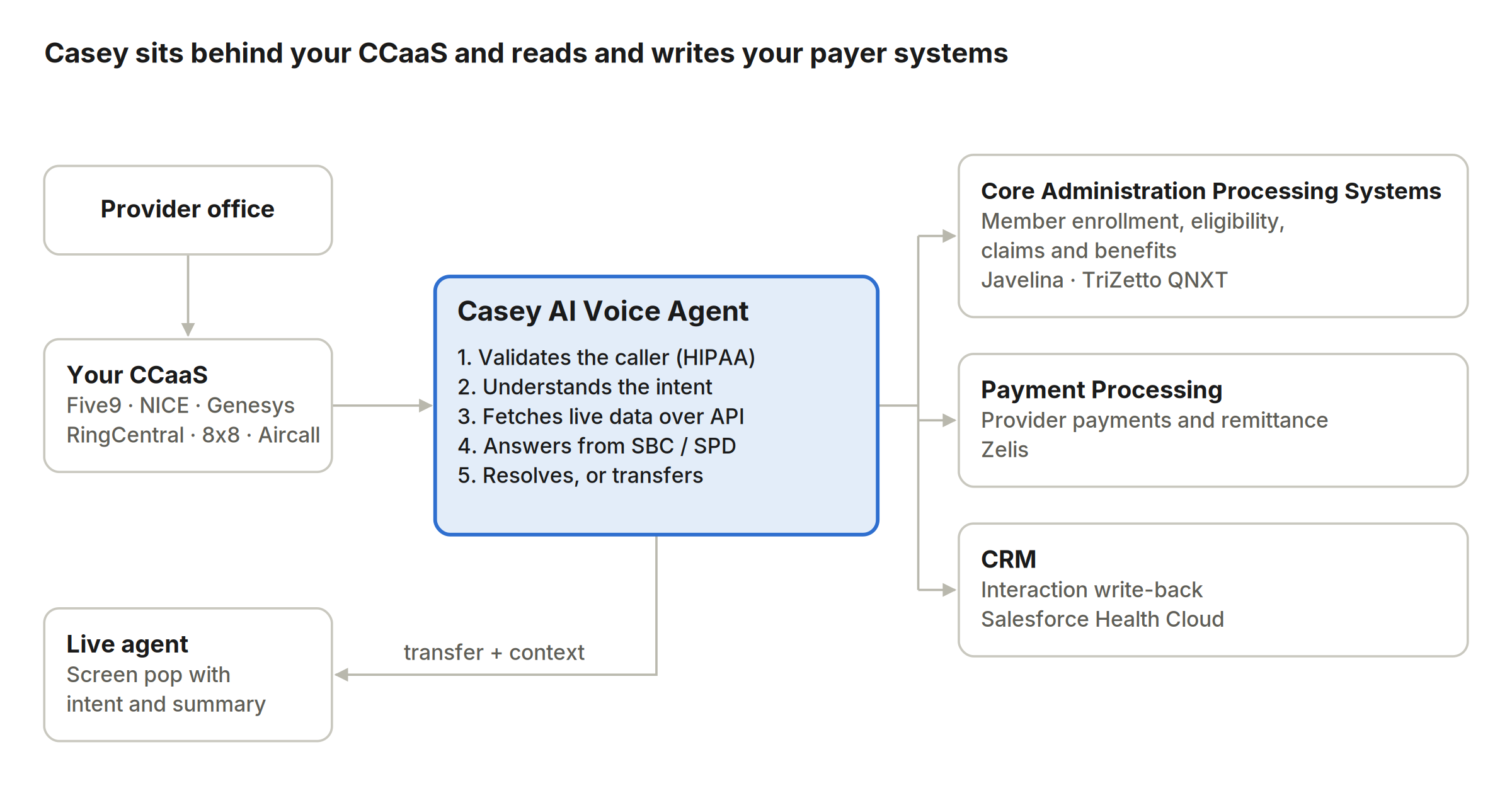
Most AI Voice Agents you see in demonstrations can converse naturally. However, the difference between a demo and production deployment is that the agent can respond with real-time, member-specific data and it can provide a clear record of what it did. In case of provider calls, it comes down to a few integration layers.
Core Administration: Eligibility, Benefits and Accumulators
Your Core Administrative Processing System is the source of truth for your covered population, covered plan, and how much of the deductible and out-of-pocket maximum has been met. Health plans and TPAs operate platforms like TriZetto (Facets, QNXT), HealthEdge (HealthRules Edge), WLT and Mphasis (Javelina), which are decades old and have limited APIs. That is why integration, more than conversation, usually sets the timeline.
During the health plan call, an AI voice agent must fetch data from these systems.
Claim: status, payments and write-back to CRM
A claim status call is more than a lookup. An AI Voice Agent has to search the right claim and clearly explain the status - whether it's pending, paid or denied. If the Claim is paid, the AI Agent needs to provide the paid amount and check or EFT date. For denied claims, the AI Voice Agent needs to explain the denial reason in plain English and allow to seamlessly transfer for an appeal or grievance.
Writing is as important as reading. The AI Voice Agent should log the summary of the call in the CRM (for example, Salesforce Health Cloud). That way your representatives and auditors can see exactly what the AI did on each call.
Plan documents and guardrails
Benefit answers have to come from your plan documents, not a model’s general knowledge. Casey grounds answers in every member’s Summary of Benefits and Coverage (SBC) and SPD, reads required disclaimers word-for-word and applies the language model for limited purposes within a structured conversation. Providing a very narrow and relevant context is the key. This is what keeps answers consistent from one group of an employer plan to another for a TPA that administers many employer plans.
SIP Trunk and Event Webhook Integration with your CCaaS platform
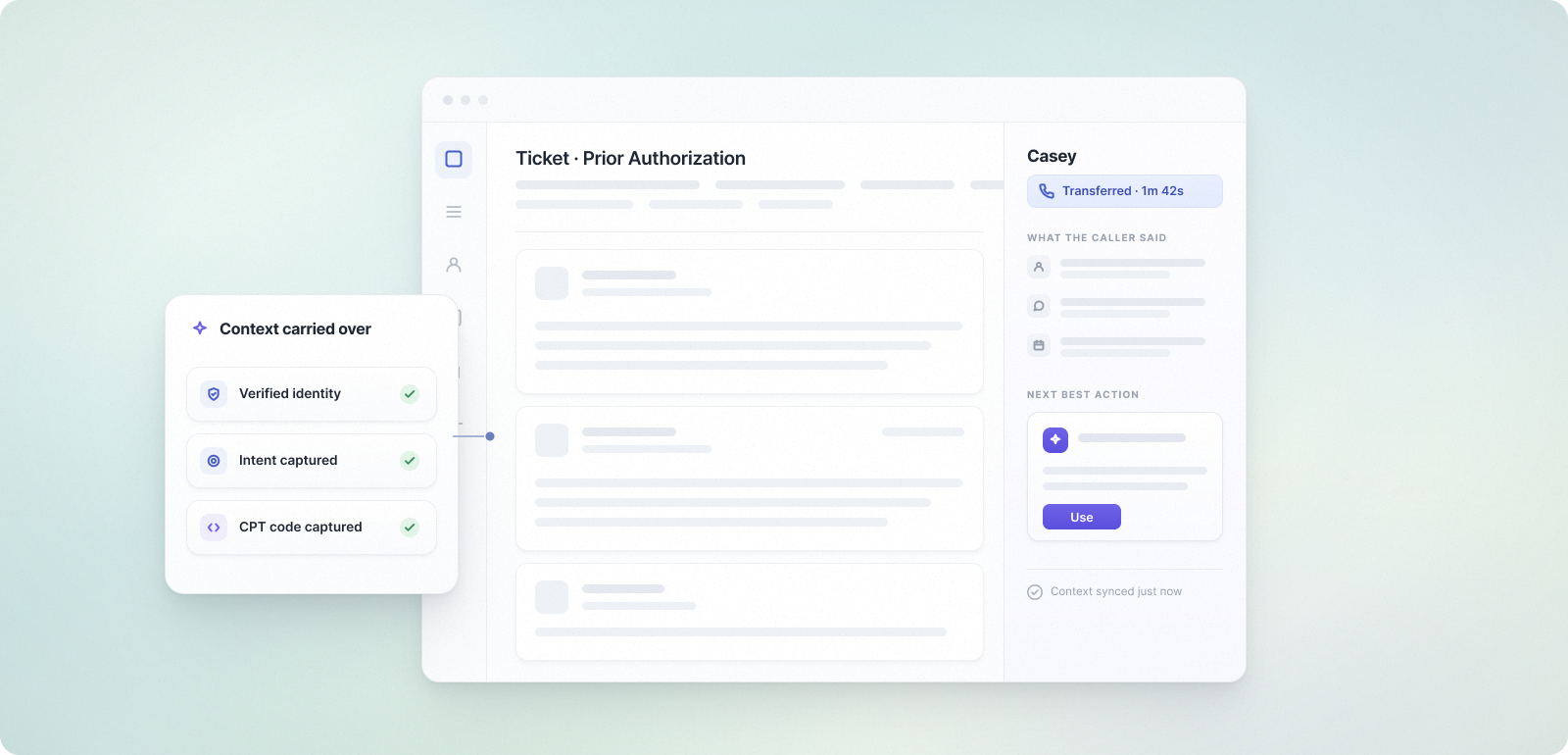
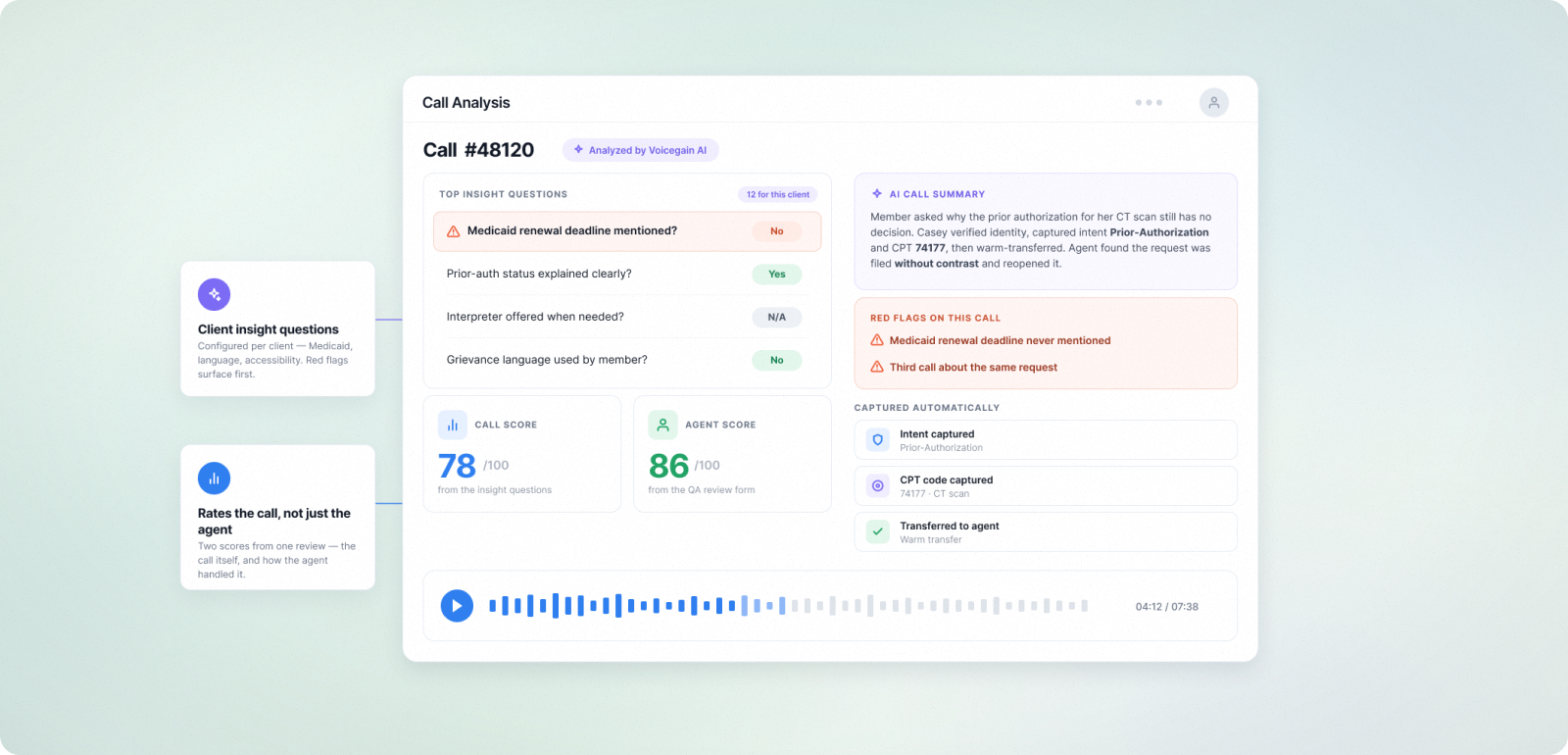
An AI Voice Agent must integrate with your existing Call Center platform. Casey is an approved AI Voice Agent ISV on leading CCaaS platforms including Five9, NICE CXOne, Genesys, Aircall, RingCentral and 8x8. You can direct provider calls to Casey via a phone number or using SIP Trunks. When call gets transferred to the provider queue for live agent assistance, Casey monitors the key CTI events through CCaaS Webhooks. When a call is answered by the Agent, they get a screen pop with full context of the caller's intent, HIPAA Validation status, and a summary of the interaction, so the provider doesn't have to start over. Casey Co-Pilot allows the representative to continue receiving assistance throughout the call, while the human retains control of all responses. We cover how that works in our blog on Agent Assist AI governance.
Security and hosting
Provider calls contain plenty of PHI and the deployment timeline is often determined by security review. Casey runs either in Voicegain’s Cloud under a Business Associate Agreement, with HIPAA, SOC 2 Type 2 and PCI DSS compliance or inside your own virtual private Cloud so PHI stays in your network.
On the Ground Results & Outcomes
Voicegain Casey is live-in production with over a dozen TPA and Health Plans. We have been taking live production calls since October 2024. Voicegain Casey has handled over 2M calls and we have truly optimized Casey over the years to maximize automation rates and caller experience. We can guarantee automation rates of at least 30%. We also forecast an automation rate of 40% - 50% over 12 months, as the AI Voice Agent providing access to all the key APIs and callers to get familiar with the AI Voice Agent.
Providers are turning to AI Voice Agents too
Providers have already joined the bandwagon of adopting AI Voice Agents. Health systems and billing companies are using AI Voice Agents to make calls to payers for eligibility, benefits, claim status and prior authorization related queries. Payers, on the other hand, are still deciding on automating providers and members calls.
If payers, like providers, use AI Voice Agents for handling providers and members calls, it will be a win-win situation for both. With automation on both sides, a typical call will get resolved in just a few minutes with no hold time. It’s time for health plans and TPAs to think more about automation and how AI Voice Agents handles repetitive and predictable calls much better.
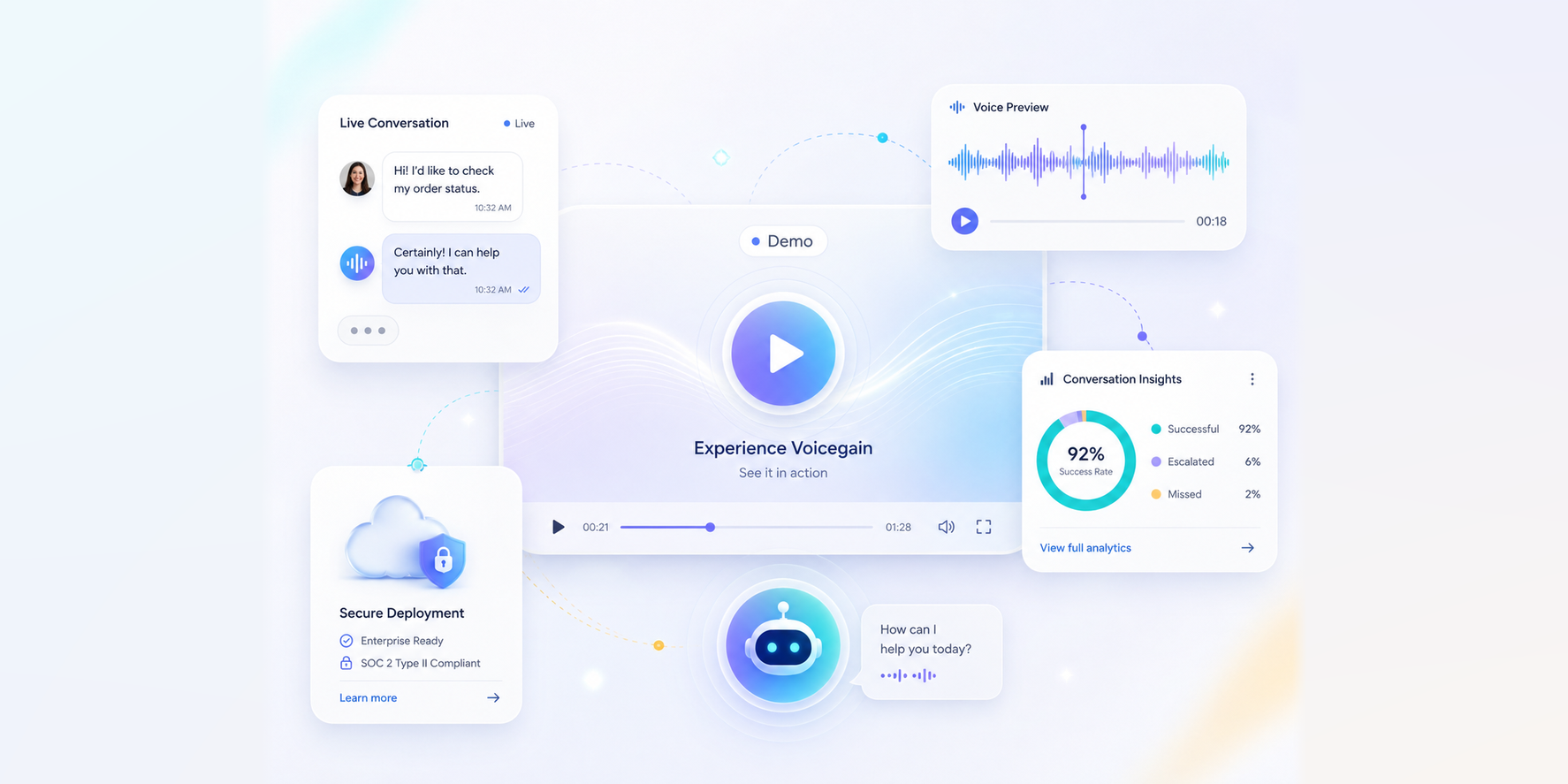
Try Casey demo to see how Casey handles an eligibility call or talk to our experts if you’re planning to automate your provider calls at your health plan or TPA.
Frequently Asked Questions
Which provider calls can be automated?
The best candidates are high-volume, structured calls: eligibility verification, benefits by procedure code, claim status, EOB faxback, and prior authorization status. Casey handles each of these end to end after validating the caller.
Do we need to replace our IVR or CCaaS platform?
No. Casey sits behind your existing CCaaS platform. You route calls to it by phone number or SIP URI, and it transfers to your live agents with full context when needed.
How does the AI avoid giving wrong benefit information?
Benefit answers come from your own plan documents and live system data, not the model's general knowledge. Required disclaimers are read verbatim, and the language model works within a structured dialog with strict guardrails.
How long does integration take?
Since Casey's payer intents are pre-built, most integrations go live in a 4-8 weeks, depending mainly on API access to your eligibility and claims systems and your security review.
Published