.png)
.png)
.png)



Your Medicaid Renewal Volume Doubles in 2027. Your Headcount Doesn’t
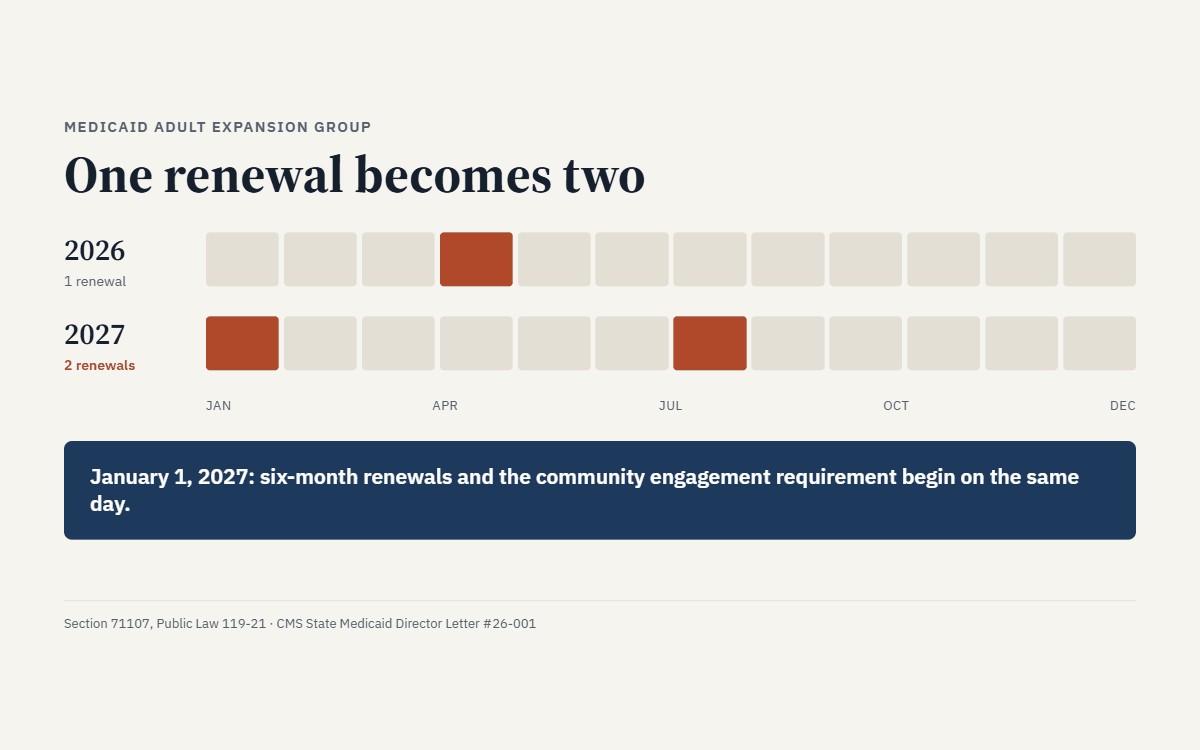
Most health plans treat Medicaid redeterminations as a solved case. States unwound continuous coverage in 2023, contact centers absorbed the surge, and renewals went back to an annual cycle. That’s about to change again, and this time it won’t be a one-time surge.
Starting January 1, 2027, states must redetermine eligibility for the Medicaid adult expansion group every six months instead of every 12 months. Section 71107 of Public Law 119-21 set that requirement and CMS spelled out the details in SMD #26-001. On the same date, many of those members must also prove they meet a community engagement requirement, meaning work, school, job training or volunteer hours, to stay enrolled. Most affected enrollees need 80 hours a month unless they qualify for an exemption.
The same renewal conversation now happens twice as often, and it comes with a new compliance question. Hiring temporary staff or getting overtime approved by finance might have worked in 2023 but is going to be much harder in 2027. That won’t hold up against a surge that repeats every six months.
%402x.png)
Procedural disenrollment is a revenue problem.
Here’s the number that gets a CFO’s attention. Most members who lose coverage at renewal aren’t actually ineligible. Their notice went to an old address. They didn’t understand what the state was asking for. They called with a question and couldn’t get through in time.
CMS projects a combined 15% disenrollment among affected members: 8.9% from beneficiary noncompliance and other 6.4% from procedural reasons like a missed form or an outdated address, according to Avalere Health's analysis. That second number is the one to bring to your finance team. Those are eligible members leaving the plan for administrative reasons. Each one costs the Plan revenue for as long as the gap lasts, plus the cost of re-enrolling them later. Members with chronic conditions tend to call in and get help. Healthier members often just disappear. A twice-yearly cycle doubles the number of chances to lose them.
This is why renewal outreach belongs in the revenue conversation, not the contact center budget. The two numbers to track are the renewal response rate and the procedural disenrollment rate.

What plans can and can’t do.
The boundary matters here, because it shows exactly where the opportunity sits. CMS’s interim final rule doesn’t let managed care organizations decide whether a member meets the eligibility or work requirement. It also limits how much of that process states can hand off to plans in the first place, according to this analysis from Holland & Knight. States can delegate certain tasks. Only the state can make the final call.
That still leaves plenty of work to do — telling members a renewal is coming, keeping their contact information current, explaining what the state needs and answering the phone when they call. All of it is high-volume, repetitive and deadline-bound, which is exactly what Voice AI handles well.

Where Voicegain Casey fits
Casey doesn’t decide who is eligible. The state does that. Casey makes sure the member knows what’s due, knows where to send it, and gets an answer before time runs out.
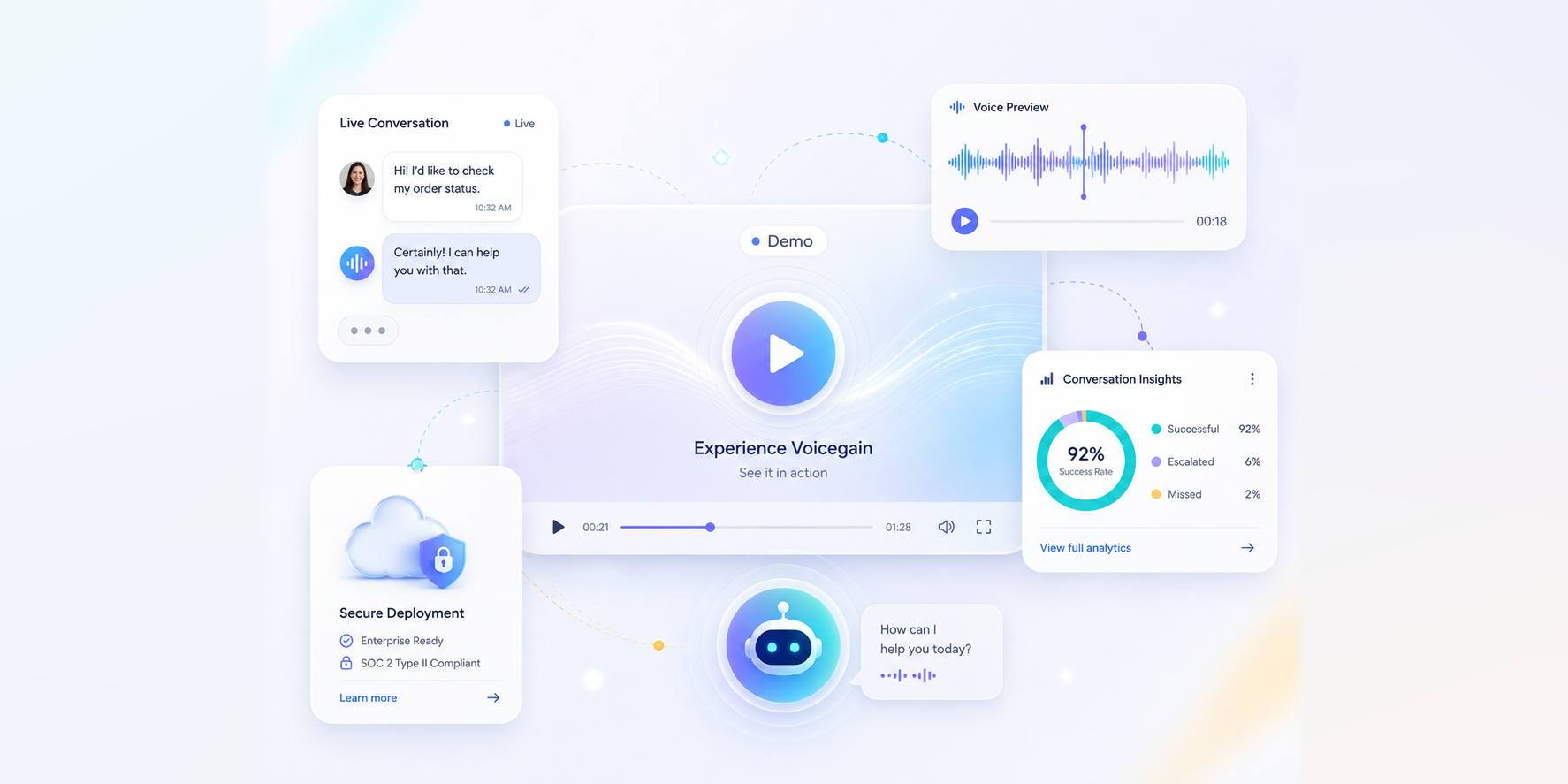
The outreach itself is the part most plans can't staff twice a year: reaching members ahead of a deadline, confirming the contact information on file, and explaining in plain language what the notice is asking for. Casey is built to run that outreach as a conversation rather than a recorded reminder — a member can interrupt with a question and get an answer.
When the notice goes out, the phones light up. Casey’s AI Voice Agent answers those calls around the clock answering frequently asked questions. This matters more for Medicaid members than commercial ones, since many can’t call during a nine-to-five workday. If a call needs a person, Casey can schedule a callback at the member's convenience.
While a live agent is on the call, Casey Co-Pilot listens in and surfaces the right answer from plan documents and policy in real time, then writes the notes afterward. During a renewal surge, when plans are leaning on newly hired staff, that support can make a new hire sound like someone who’s done the job for years.
Casey QA and Analytics also scores every call for quality, sentiment, and compliance. When a state partner or your own board asks how members experienced the transition, that’s an answer backed by data instead of a guess.
The Recovery Window Nobody Works
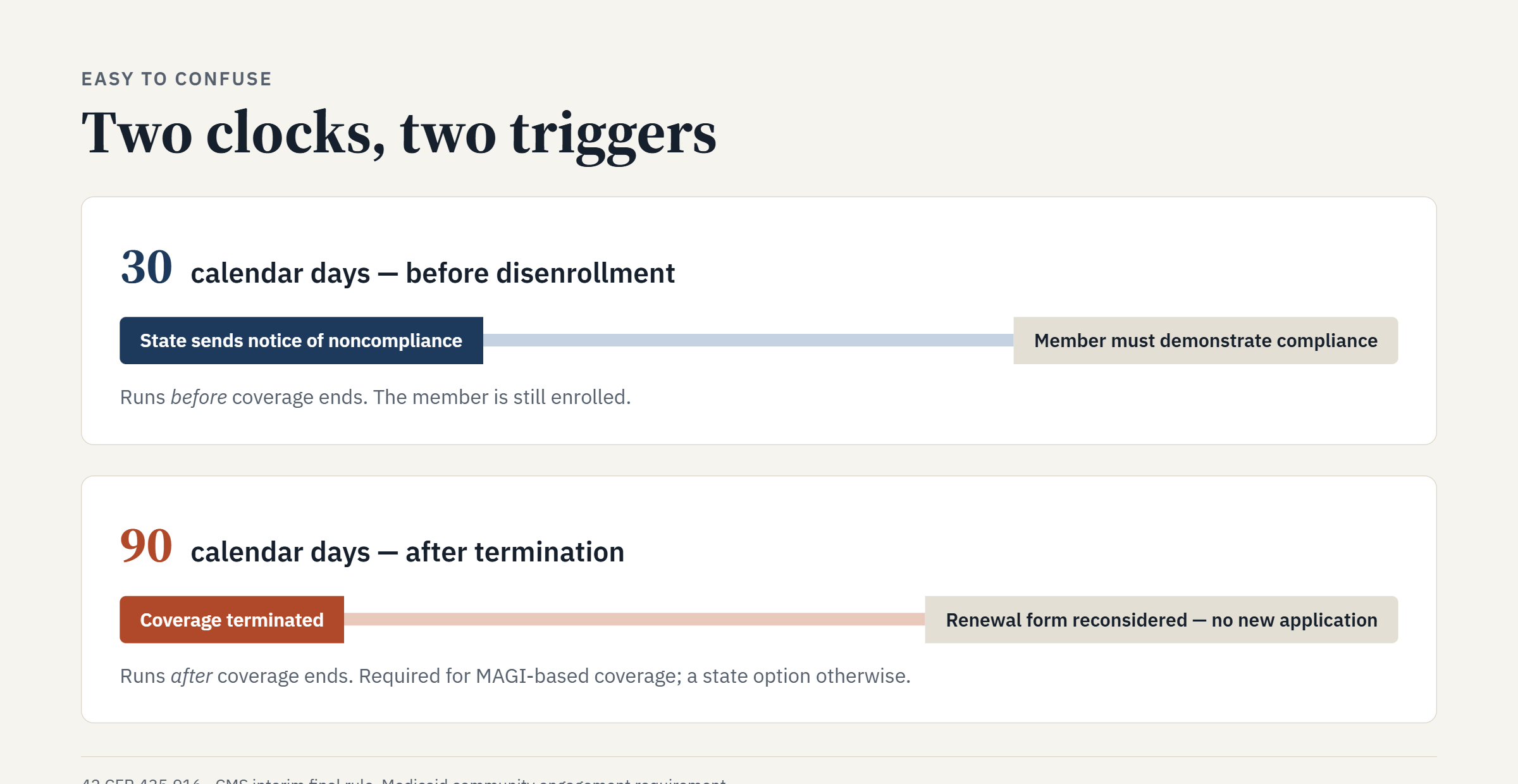
Federal rules give members a second chance. Say a member loses coverage because they didn’t return paperwork in time. If they submit that same renewal form within 90 calendar days of termination, the state must treat the form itself as their application and reconsider eligibility. No new application is required. Federal rules require this for MAGI-based coverage, which is the same population moving to six-month renewals. For non-MAGI pathways it's a state option rather than a federal requirement.
Every member you've lost to a paperwork mistake sits inside that 90-day window, and every one of them can still be won back without starting over. Almost no plan works on that list systematically, because it means calling a lot of people for a small payoff each time. That makes it a hard list for staff and an easy one to automate.
One more date worth knowing: before a state can disenroll someone for noncompliance, it must send a notice and give the member 30 calendar days to respond. That’s a different clock from the 90-day window to recover a member after coverage has already ended.
January is a date, not a forecast.
Renewal volume is about to double. Contact center headcount isn’t going to double with it. The plans that treat renewal outreach as a way to keep members, not just a cost to manage, will hold onto members everyone else loses to paperwork.
Published